
Appearance
UDINA Go - Offline-first. Web-native. Everywhere.
The mobile companion of the UDINA Commerce family — for Android and iOS.
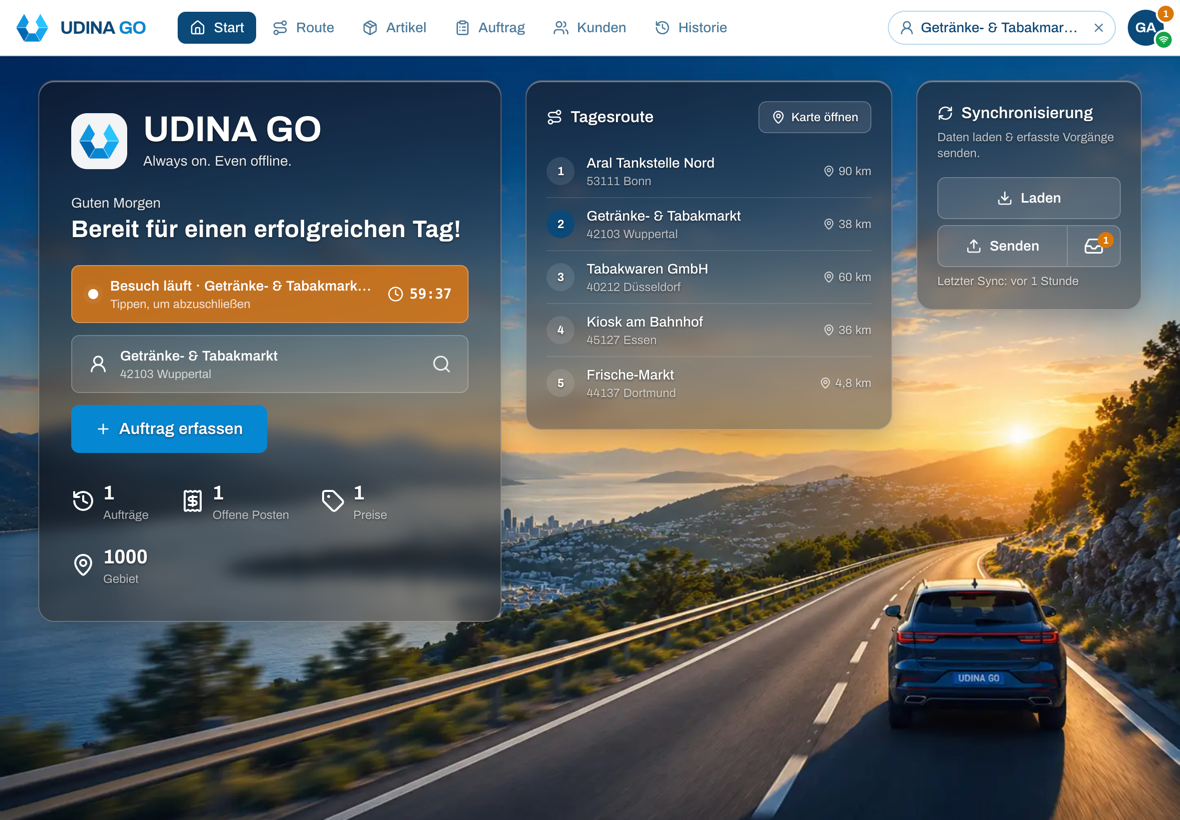
Yesterday unthinkable. Today, the new freedom.
Next to Trade and Spares, say hello to Go — an offline-capable, web-native companion app. Go for your sales reps in the field. Go Service for your service technicians on site.
Trade and Spares online. Go offline-first and online. Four very different jobs to be done. One stack for all of them.
One family, one stack
The entire UDINA Commerce family runs on SAP CAP on the backend and React on the front — and delivers one consistent UX across every device your team touches. Desktop, tablet, phone. Connected or not. The mobile members are packaged with Capacitor, so Go and Go Service ship as real Android and iOS apps from the same code base.
Editions
| Edition | For | Typical scenario |
|---|---|---|
| Go | Sales representatives in the field | Customer visits, on-site quotations, order entry, product and price information |
| Go Service | Service technicians on site | Service orders, on-site documentation, spare parts identification and ordering |
The UDINA Commerce Family
| Solution | Audience | Channel | Rendering | SEO | Connectivity |
|---|---|---|---|---|---|
| Trade | B2B | Web shop for trade business | SPA | — | online |
| Spares | B2B | Spare parts commerce | SPA | — | online |
| Go | B2E | Mobile sales companion | SPA | — | offline-first and online |
| Go Service | B2E | Mobile service companion | SPA | — | offline-first and online |
| Retail PLANNED | B2C | Web shop for end consumers | SSR | ✓ | online |
B2B — your customers order themselves. B2E — your own sales and service teams work on behalf of the customer. B2C — end consumers, reached through public search.
SEO — only public pages can be indexed at all; the authenticated members are deliberately kept out of the index.
Retail is on the roadmap
UDINA Commerce Retail is planned and available on request. Talk to us about your B2C scenario
Why Retail renders differently
Trade, Spares, Go and Go Service all live behind authentication. Every visitor is a known business partner or one of your own employees, there is nothing for a crawler to index, and sessions are long. That is exactly the profile a Single Page Application is built for: load the app shell once, then talk to the CAP services directly — every subsequent interaction avoids a full page round trip.
Retail is public, and that inverts the requirements. Category and product detail pages have to be found before they can convert, which means they must return meaningful HTML on the very first request, carry per-page metadata (title, description, canonical URL, Open Graph) and expose structured data such as schema.org/Product with price and availability. A client-rendered SPA cannot deliver that reliably — and it pays twice, because the Core Web Vitals that suffer from client-side rendering (above all LCP) are themselves ranking signals. So Retail is rendered on the server and hydrated in the browser: same React components, same design system, same CAP services — different delivery.
| Aspect | Trade / Spares / Go | Retail |
|---|---|---|
| Access | authenticated | public |
| Rendering | client-side (SPA) | server-side (SSR) + hydration |
| Search engines | irrelevant, noindex | business critical |
| Metadata | one app shell | per category and product page |
| Structured data | not required | schema.org/Product, price, availability |
| Caching | per user, per session | CDN-cacheable pages |
| Leading metric | interaction speed in long sessions | LCP, crawlability, organic conversion |
SEO support in Retail
SEO is not a switch you flip on a finished shop — it is a set of capabilities the rendering architecture has to provide. Retail ships them; Trade, Spares and Go have no use for them:
- Server-rendered HTML — every category, product and content page is complete on first response, with no JavaScript execution required to see the content
- Per-page metadata — title, meta description, canonical URL and Open Graph / Twitter Card tags derived from the actual product and category data
- Structured data —
schema.org/Productwith price, currency, availability and reviews, plusBreadcrumbListandOrganization, so results can qualify for rich snippets - Clean URL structure — readable, stable, language-specific paths instead of hash or query-parameter routing
sitemap.xmlandrobots.txt— generated from the live catalog, so new products enter the index without manual work- International SEO —
hreflangfor multi-language and multi-country catalogs - Core Web Vitals — server rendering, image optimization and CDN caching target LCP, CLS and INP directly, because they are ranking signals and not just a lab metric
- Faceted navigation control — filter and sorting combinations are indexed selectively instead of flooding the index with near-duplicate pages
The trade-off is deliberate
Adding this to an authenticated B2B shop would cost rendering complexity and cache invalidation effort with no return — nobody searches Google for a page only three purchasing agents may open. That is why the family does not force one rendering mode on all members: the delivery follows the audience.
Key Features
- Offline-capable — full operation without connectivity, automatic synchronization once back online
- Web-native — one React code base, packaged with Capacitor into installable Android and iOS apps; no platform-specific rewrites, no second team
- Native device access — camera, geolocation, secure storage, local persistence and background sync through Capacitor plugins, not a browser tab in disguise
- Store distribution — deployed through Apple App Store, Google Play or your own mobile device management
- Consistent UX — the same design language and interaction patterns as the web-based family members
- SAP-integrated — SAP CAP backend with native integration into SAP S/4HANA or the SAP Business Suite
- Multi-device — desktop, tablet and phone from a single stack
Why UDINA Go?
This is what AI-driven development actually unlocks: customer-specific application suites instead of uniform apps with a logo slapped on top.
Think tailored suit, not off the rack.
Off the rack fits nobody perfectly. It just fits everybody a little. Your sales process, your service workflows, your product logic, your customers — none of that is standard, so why accept standard software on top of it?
Every business is unique. Now the software behind it can be, too.
Ready to Get Started?